What Is the Biggest Problem With Hydrogen Cars Explained
The biggest problem with hydrogen cars comes down to infrastructure and cost. Most drivers will never see a hydrogen refueling station, and filling up costs far more than charging an electric vehicle. These two barriers make hydrogen cars impractical for everyday use, despite their impressive range and quick refueling times.
Key Takeaways
- Infrastructure Gap: There are fewer than 1,000 hydrogen refueling stations worldwide, making it nearly impossible for most people to own a hydrogen car.
- High Costs: Both hydrogen fuel and the vehicles themselves carry a steep price tag compared to electric cars.
- Production Challenges: Most hydrogen is still produced from fossil fuels, which undermines its green credentials.
- Efficiency Losses: The energy conversion process from hydrogen to motion wastes a lot of energy compared to battery electric vehicles.
- Limited Models: Only a handful of hydrogen car models exist on the market, giving consumers very few choices.
- Future Potential: Despite current problems, hydrogen fuel cell technology may still find a niche in heavy transport and industry.
📑 Table of Contents
- The Core Problem With Hydrogen Cars
- The Refueling Problem in Detail
- The High Cost of Hydrogen Fuel and Vehicles
- Hydrogen Production: Not as Green as You Think
- Hydrogen Cars vs Electric Cars: The Real Comparison
- Common Mistakes People Make About Hydrogen Cars
- What Does the Future Hold for Hydrogen Cars?
- Key Takeaways
The Core Problem With Hydrogen Cars
Hydrogen cars sound amazing on paper. They emit nothing but water vapor. They can refuel in minutes. They offer long driving ranges. So why aren’t they everywhere? The answer is simple but hard to fix. The biggest problem with hydrogen cars is the lack of a proper refueling infrastructure.
When you buy a hydrogen car, you need somewhere to fill it up. Unlike electric vehicles, which you can charge at home or at thousands of public charging points, hydrogen refueling stations are rare. In the United States, there are fewer than 60 stations, and nearly all of them sit in California. Europe has a few hundred more, but that’s still nothing compared to the tens of thousands of gas stations and EV chargers available today.
This infrastructure gap creates a chicken-and-egg problem. Car makers won’t build more hydrogen vehicles without stations. Energy companies won’t build stations without cars. And consumers won’t buy cars without both. The result is a market stuck in place.
Why Infrastructure Matters So Much
Think about it this way. You wouldn’t buy a gasoline car if there were only one gas station in your entire state. The same logic applies to hydrogen cars. Convenience drives adoption. People need to know they can refuel easily and quickly. Without that confidence, even the best fuel cell vehicle will struggle to find buyers.
Building new refueling stations is incredibly expensive. A single hydrogen station costs between 1 and 2 million dollars to install. The stations also require specialized equipment to compress and store hydrogen safely. This makes expansion slow and costly, especially when compared to the rapid growth of electric vehicle charging networks.
The Refueling Problem in Detail
The refueling infrastructure issue is the single largest barrier for hydrogen cars. Let’s break down why this problem is so stubborn and what makes it different from the challenges facing battery electric vehicles.
Where Are the Stations?
Hydrogen refueling stations are concentrated in a few regions. California leads in the United States. Germany, Japan, and South Korea have some stations too. But the vast majority of the world has zero access to hydrogen refueling. If you live in Texas, New York, or most of Europe, you simply cannot buy hydrogen fuel for your car.
This geographic limitation makes hydrogen cars impractical for most people. Even if you could find a station nearby, you might need to drive out of your way just to fill up. That defeats the purpose of a car, which is supposed to make your life easier.
The Cost of Building Stations
Building a hydrogen refueling station requires serious investment. The station needs high-pressure storage tanks, compressors, and safety systems. Hydrogen is a tricky fuel to handle. It’s highly flammable and requires special containment. All of this adds to the cost and complexity.
Compare that to an electric vehicle charging station. A basic Level 2 charger costs a few hundred dollars to install. Even fast DC chargers run 20,000 to 50,000 dollars. A hydrogen station? You’re looking at over a million dollars. The cost difference is enormous, and it explains why hydrogen infrastructure grows so slowly.
Quick Tips for Prospective Hydrogen Car Buyers
- Check your local hydrogen station map before buying a hydrogen car.
- Consider whether you can install a home charging setup for an electric car instead.
- Look into hydrogen car leasing programs, which sometimes include fuel delivery.
- Keep an eye on government incentives that may help offset the cost of hydrogen fuel.
The High Cost of Hydrogen Fuel and Vehicles
Infrastructure isn’t the only problem. The cost side of hydrogen cars is also a major headache. Both the vehicles and the fuel are expensive, and that makes hydrogen cars hard to recommend for most buyers.
Why Hydrogen Cars Are So Expensive
A hydrogen fuel cell vehicle costs significantly more than a comparable electric car or gasoline car. The Toyota Mirai, one of the most well-known hydrogen cars, starts around 50,000 dollars. That’s a lot for a car with limited model options and no home refueling option. The fuel cell stack itself is expensive to manufacture, and platinum, a key material in the stack, drives up costs even further.
Compare that to a Tesla Model 3 or a Chevrolet Bolt, which start well under 30,000 dollars. The price gap is huge, and it’s hard to justify spending more on a hydrogen car when electric alternatives are cheaper and more practical.
The Price of Hydrogen Fuel
Hydrogen fuel costs vary by region, but it’s almost always more expensive per mile than electricity for an EV. In California, hydrogen costs around 16 to 18 dollars per kilogram. A Toyota Mirai gets about 60 miles per kilogram, which puts the fuel cost at roughly 27 cents per mile. Compare that to an electric car, which might cost 4 to 5 cents per mile at home charging rates.
That’s a massive difference. Over a year of driving, you could save thousands of dollars by choosing an electric car over a hydrogen car. The fuel cost alone makes hydrogen vehicles hard to justify for everyday drivers.
| Factor | Hydrogen Cars | Electric Cars | Gasoline Cars |
|---|---|---|---|
| Starting Price | 50,000+ USD | 25,000+ USD | 20,000+ USD |
| Fuel Cost per Mile | 25-30 cents | 4-5 cents | 10-15 cents |
| Refueling/Charging Time | 5-10 minutes | 20-60 minutes (fast) | 3-5 minutes |
| Range | 300-400 miles | 250-350 miles | 300-500 miles |
| Refueling Stations | Very limited | Widely available | Ubiquitous |
| Home Refueling Option | No | Yes | N/A |
| Emissions | Zero tailpipe | Zero tailpipe | CO2 and pollutants |
Hydrogen Production: Not as Green as You Think
One of the biggest selling points for hydrogen cars is that they produce zero tailpipe emissions. That’s true. But the full picture is more complicated. How the hydrogen is made matters a lot, and most hydrogen today is far from clean.
Grey, Blue, and Green Hydrogen
Not all hydrogen is created equal. The industry uses color codes to describe how hydrogen is produced. Grey hydrogen comes from natural gas through a process called steam methane reforming. This method releases carbon dioxide into the atmosphere. Most hydrogen produced today is grey.
Blue hydrogen also uses natural gas but captures the carbon emissions and stores them underground. This is better, but it still relies on fossil fuels and doesn’t eliminate all emissions.
Green hydrogen is made by splitting water using renewable electricity. This is the cleanest method, but it’s also the most expensive. Green hydrogen currently costs two to three times more than grey hydrogen, which makes it hard to scale.
The Energy Efficiency Problem
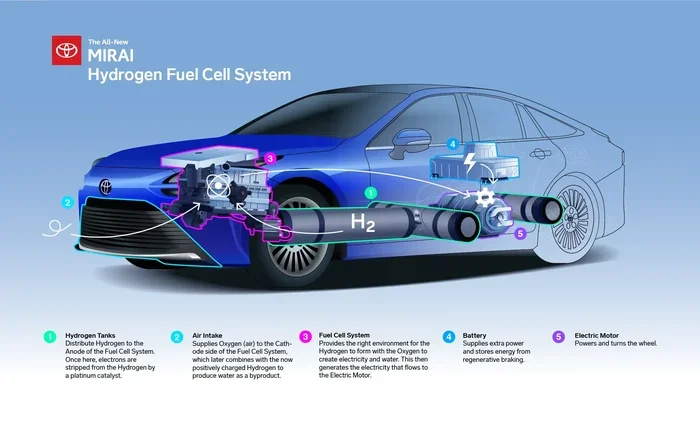
Even when hydrogen is produced cleanly, the overall energy efficiency is poor. Here’s why. You start with electricity to make hydrogen through electrolysis. Then you compress, transport, and store the hydrogen. Then you convert it back to electricity in the fuel cell. At each step, energy is lost.
The result is that hydrogen cars use roughly two to three times more energy than battery electric vehicles to travel the same distance. From a pure energy standpoint, charging an electric car directly with renewable electricity is far more efficient than making hydrogen, transporting it, and converting it back to power.
Expert Insight
Dr. Joseph Romm, a physicist and energy expert, has noted that hydrogen fuel cells work best in applications where batteries fall short, like long-haul trucking and industrial equipment. For passenger cars, battery electric vehicles are simply more efficient and practical. The energy losses in hydrogen production and distribution make it hard to compete with direct electrification for everyday driving.
Hydrogen Cars vs Electric Cars: The Real Comparison
The debate between hydrogen cars and electric cars comes down to a few key factors. Both technologies have strengths and weaknesses. Understanding them helps explain why electric vehicles dominate the passenger car market while hydrogen struggles to gain traction.
Range and Refueling Time
Hydrogen cars do have an advantage when it comes to refueling speed. Filling a hydrogen tank takes about 5 to 10 minutes, similar to gasoline cars. Electric cars take longer, even with fast chargers. A Tesla Model 3 can charge from 10 to 80 percent in about 25 minutes at a fast charger.
In terms of range, hydrogen cars like the Toyota Mirai offer 300 to 400 miles per tank. That’s competitive with gasoline cars and comparable to many electric vehicles. On paper, hydrogen cars seem to solve the range and refueling problems that early electric cars faced.
The Practical Reality
But here’s the catch. Most people charge their electric cars at home overnight. They wake up every morning with a full tank and never need to visit a public charger for daily driving. Hydrogen car owners have no equivalent convenience. They must find a public refueling station every time they need fuel.
This difference in daily usability is huge. It’s one thing to have fast refueling in theory. It’s another to actually have a station nearby when you need it. For most drivers, the home charging advantage of electric cars outweighs the refueling speed advantage of hydrogen cars.
Environmental Impact
Both hydrogen cars and electric cars produce zero tailpipe emissions. But the environmental footprint depends on how the energy is generated. An electric car charged with solar or wind power has a very low carbon footprint. A hydrogen car running on green hydrogen does too, but green hydrogen is rare and expensive.
Most hydrogen cars today run on hydrogen made from natural gas. That means their overall carbon footprint is not as clean as it might seem. Electric cars, even when charged from the grid, tend to have a lower carbon footprint because the electrical grid is getting cleaner faster than hydrogen production is.
Common Mistakes People Make About Hydrogen Cars
There are several misconceptions that hold people back from understanding hydrogen cars properly. Avoiding these mistakes helps you see the technology more clearly.
- Mistake 1: Assuming hydrogen is a clean fuel by default. Most hydrogen is grey, not green. Always ask how the hydrogen is produced before assuming it’s environmentally friendly.
- Mistake 2: Overestimating the availability of refueling stations. Hydrogen stations are rare. Don’t assume you’ll have easy access, especially outside major metro areas.
- Mistake 3: Ignoring the total cost of ownership. The purchase price is high, and fuel costs are steep. Factor in both before comparing hydrogen cars to electric or gasoline alternatives.
- Mistake 4: Confusing hydrogen fuel cells with hydrogen combustion engines. Some people think hydrogen cars burn hydrogen like gasoline. Most hydrogen cars use fuel cells to convert hydrogen into electricity. The two are very different technologies.
- Mistake 5: Dismissing hydrogen entirely. Hydrogen may still play a role in heavy transport, buses, and industrial applications. The technology isn’t dead, it just isn’t the best fit for passenger cars today.
What Does the Future Hold for Hydrogen Cars?
Despite the challenges, hydrogen fuel cell technology isn’t going away overnight. Several countries and companies are still investing in hydrogen infrastructure and fuel cell research. The question is whether hydrogen cars can overcome their biggest problems and find a viable path forward.
Where Hydrogen Might Shine
Hydrogen fuel cells may find their best applications outside of passenger cars. Heavy-duty trucks, buses, and delivery vehicles could benefit from hydrogen’s quick refueling and long range. In these applications, battery weight and charging time become bigger problems, and hydrogen starts to make more sense.
Industrial uses are another promising area. Hydrogen is already used in refining, ammonia production, and steel manufacturing. Expanding green hydrogen production for industrial purposes could drive down costs and create a foundation for broader adoption.
The Role of Government and Investment
Government incentives could help hydrogen cars gain ground. Tax credits, subsidies for hydrogen stations, and investments in green hydrogen production could lower costs and improve availability. The U.S. Inflation Reduction Act includes provisions for clean hydrogen production, which could help reduce the cost of green hydrogen over time.
But even with strong government support, the fundamental challenges remain. Building a nationwide hydrogen refueling network takes massive investment and time. And battery electric vehicles continue to improve rapidly, with faster charging, longer ranges, and falling prices. The competitive landscape is tough for hydrogen cars.
What This Means for You
If you’re considering a hydrogen car today, be realistic. You need access to hydrogen refueling stations, you’ll pay more for fuel, and your choices are limited to a few models. For most people, a battery electric vehicle is a more practical and affordable choice right now.
That said, hydrogen technology continues to improve. Fuel cell costs are coming down. Green hydrogen production is scaling up. The biggest problem with hydrogen cars might not be permanent. But for the foreseeable future, infrastructure and cost will remain the two biggest hurdles standing in the way of widespread hydrogen car adoption.
Key Takeaways
- Infrastructure is the biggest barrier: Hydrogen refueling stations are scarce and expensive to build, making hydrogen cars impractical for most drivers.
- Costs remain high: Both the vehicles and the fuel cost significantly more than electric car alternatives.
- Production matters: Most hydrogen is still made from fossil fuels, which limits its environmental benefits.
- Efficiency is lower: Hydrogen cars lose more energy through production and conversion than battery electric vehicles.
- Niche potential exists: Hydrogen may find success in heavy transport and industrial applications where batteries struggle.
- Electric cars lead the passenger market: For everyday driving, battery electric vehicles offer better convenience, lower costs, and wider availability.
Frequently Asked Questions
Why are hydrogen cars not more popular?
The biggest problem with hydrogen cars is the lack of refueling infrastructure and high costs. There are very few hydrogen stations, and both the vehicles and fuel are expensive compared to electric and gasoline alternatives. These barriers make hydrogen cars impractical for most everyday drivers.
Can you install a hydrogen refueling station at home?
No, home hydrogen refueling is not currently practical for most people. The equipment is expensive, requires special safety certifications, and hydrogen storage at home is complex. This is a major disadvantage compared to electric cars, which can simply be plugged into a home outlet or charger.
Are hydrogen cars better for the environment than electric cars?
It depends on how the hydrogen is produced. Green hydrogen is clean, but it’s rare and expensive. Most hydrogen today is grey, made from natural gas, which produces carbon emissions. Battery electric vehicles generally have a lower overall carbon footprint because electricity generation is cleaner and more efficient than hydrogen production.
How long does it take to refuel a hydrogen car?
Refueling a hydrogen car takes about 5 to 10 minutes, which is similar to gasoline cars and faster than most electric car charging. This is one of the main advantages of hydrogen fuel cell vehicles. However, the limited availability of stations means this speed advantage is rarely useful in practice.
What is the lifespan of a hydrogen fuel cell?
Hydrogen fuel cells typically last around 5,000 to 10,000 hours of operation before needing replacement. That translates to roughly 150,000 to 200,000 miles for most driving patterns. The fuel cell stack is one of the most expensive components, which contributes to the higher overall cost of hydrogen cars.
Will hydrogen cars ever replace electric cars?
Most experts believe hydrogen cars will not replace electric cars in the passenger vehicle market. Electric vehicles have a clear advantage in efficiency, cost, and infrastructure. However, hydrogen fuel cells may thrive in heavy-duty transport, buses, and industrial applications where their specific strengths shine.
=== CONCLUSION ===
The biggest problem with hydrogen cars comes down to two things: infrastructure and cost. Without enough refueling stations, hydrogen cars are impractical for daily use. Without affordable fuel and vehicles, they can’t compete with electric cars. These challenges are deeply connected, and solving one requires solving the other.
Hydrogen fuel cell technology is fascinating and has real potential in certain applications. But for passenger cars, battery electric vehicles have pulled ahead. They’re cheaper, more efficient, and backed by a growing charging network that makes them practical for everyday life.
If you’re exploring zero-emission vehicles, hydrogen cars are worth understanding. But for most drivers today, an electric car is the smarter, more practical choice. The future of transportation is electric, and hydrogen may play a supporting role rather than the lead. Keep watching this space, because the landscape could change. But for now, the biggest problem with hydrogen cars remains the one that’s hardest to solve: making the technology practical, affordable, and accessible for everyone.