How Do You Read a Toyota Serial Number The Easy Way
Reading a Toyota serial number is simpler than most people think. Every Toyota vehicle has a unique serial number that reveals its model year, engine type, assembly plant, and production details. In this guide, we walk you through the exact steps to decode your Toyota serial number quickly and accurately. Whether you are buying a used Toyota, verifying authenticity, or just curious about your vehicle’s history, this guide has you covered.
If you have ever stood in front of a Toyota vehicle and wondered what all those letters and numbers mean, you are not alone. The Toyota serial number might look like a secret code, but it is actually a straightforward system once you know how to read it. Whether you are a car enthusiast, a potential buyer, or just someone who wants to understand your vehicle better, learning how to decode this number is a valuable skill.
The serial number on a Toyota vehicle holds a wealth of information. It tells you the model year, the factory where it was built, the engine type, and much more. In this guide, we will break down every section of the Toyota serial number in plain, simple language. By the end, you will be able to read your Toyota serial number with confidence and use it to uncover important details about your vehicle.
We will cover everything from finding the serial number on your car to understanding what each character means. We will also share common mistakes to avoid and quick tips that make the process even easier. Let us dive in and make sense of your Toyota serial number together.
Key Takeaways
- Know Where to Look: Your Toyota serial number can be found on the dashboard, driver’s side door jamb, and vehicle documents.
- Decode Each Section: The serial number is broken into sections that reveal the manufacturer, model, engine type, and production details.
- Use Free Online Tools: Several free decoders can instantly translate your Toyota serial number into useful vehicle information.
- Avoid Common Mistakes: Do not confuse the serial number with the VIN, and always double-check the check digit for accuracy.
- Helpful for Buyers and Sellers: Knowing how to read the serial number helps verify a Toyota vehicle’s history and authenticity.
- Factory Origin Matters: The serial number tells you exactly where and when your Toyota was built.
📑 Table of Contents
What Is a Toyota Serial Number?
A Toyota serial number is a unique code assigned to every Toyota vehicle during manufacturing. Think of it as the vehicle’s fingerprint. No two Toyota vehicles share the same serial number. This code contains specific details about the car, including when it was made, where it was built, and what features it has.
Many people confuse the serial number with the Vehicle Identification Number, or VIN. While they are related, they serve slightly different purposes. The VIN is a 17-character code used worldwide to identify vehicles. The Toyota serial number, on the other hand, often refers to the full body or chassis number that includes additional manufacturing details beyond the standard VIN.
Why Does the Toyota Serial Number Matter?
Understanding your Toyota serial number matters for several important reasons. First, it helps you verify the authenticity of the vehicle. If you are buying a used Toyota, checking the serial number can reveal whether the car matches its paperwork and history report. Second, it helps with parts identification. Toyota uses specific codes within the serial number to identify the exact model, trim level, and engine variant. This makes finding the right parts much easier.
Third, the serial number is essential for recalls and service campaigns. Toyota issues recalls based on production dates and factory codes, both of which are embedded in the serial number. Finally, if you are restoring or modifying a Toyota, the serial number helps you confirm the original factory specifications.
Where to Find Your Toyota Serial Number
Finding your Toyota serial number is the first step. The good news is that Toyota places this number in several easy-to-locate spots. You do not need to be a mechanic to find it. Here are the most common places to look.
On the Vehicle Body
The Toyota serial number is typically stamped on the vehicle body in multiple locations. The most accessible spot is on the dashboard, visible through the windshield on the driver’s side. You will see a metal plate or stamped numbers on the dashboard edge.
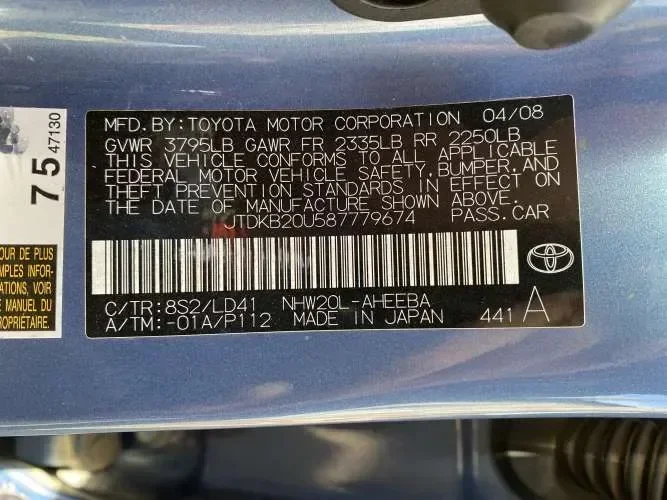
Another common location is on the driver’s side door jamb. Open the door and look for a sticker or metal plate near the latch area. This plate often contains both the serial number and the VIN. Some Toyota models also have the serial number stamped on the front fender, near the radiator support. For older models, check the chassis under the vehicle or on the rear wheel well.
On Vehicle Documents
If you cannot find the serial number on the vehicle itself, check your paperwork. The Toyota serial number appears on the vehicle title, registration card, and insurance documents. The owner’s manual may also list the serial number location for your specific model. Service records from Toyota dealerships often include the serial number as well.
| Location | What You Will Find | Ease of Access |
|---|---|---|
| Dashboard (driver side) | Serial number plate or stamped numbers | Easy |
| Driver’s side door jamb | Sticker or plate with serial number and VIN | Easy |
| Front fender | Stamped serial number | Moderate |
| Vehicle title and registration | Printed serial number | Very Easy |
| Owner’s manual | Reference to serial number location | Very Easy |
| Under the chassis | Stamped serial number | Difficult |
Quick Tip: Always take a photo of the serial number plate with your phone. This saves you time if you ever need to look it up again or share it with a dealer or mechanic.
How to Decode Each Section of the Toyota Serial Number
Now that you know where to find the serial number, let us break it down section by section. The Toyota serial number is not random. Each group of characters represents specific information about your vehicle. Understanding these sections is like learning to read a map of your car’s history.
The World Manufacturer Identifier
The first few characters of the Toyota serial number identify the manufacturer and country of origin. This is called the World Manufacturer Identifier, or WMI. For Toyota vehicles, the WMI typically starts with “J” because Japan is the country of origin for most Toyota manufacturing. The second and third characters confirm the manufacturer as Toyota.
For example, a serial number starting with “JTD” tells you the vehicle was built by Toyota Motor Corporation. Some Toyota vehicles assembled in other countries, like the United States or Thailand, may have different WMI codes. The WMI gives you immediate insight into where your Toyota was born.
The Vehicle Descriptor Section
The middle section of the Toyota serial number is the Vehicle Descriptor Section, or VDS. This part contains details about the vehicle’s model, body type, engine type, and trim level. The exact length and position of the VDS can vary depending on the Toyota model and model year.
Within the VDS, you will find the Toyota model code. This code identifies whether your vehicle is a Camry, Corolla, RAV4, Tacoma, or another model. The engine code tells you which engine variant the vehicle has. For instance, a specific letter or number combination might indicate a 2.5-liter four-cylinder engine versus a 3.5-liter V6. The trim level is also encoded here, helping you identify whether the vehicle is a base model, SE, XLE, or another trim.
The Vehicle Identifier Section
The last section of the Toyota serial number is the Vehicle Identifier Section, or VIS. This part is essentially the production sequence number. It tells you the exact order in which the vehicle rolled off the assembly line. No two vehicles share the same VIS, making it a truly unique identifier.
The VIS also encodes the model year and assembly plant. Toyota uses a specific letter or number to represent each model year in a repeating cycle. For example, the letter “A” might represent one year, “B” the next, and so on. The assembly plant code tells you which factory built the vehicle, whether it is in Toyota City, Japan, or a plant in Kentucky, Indiana, or Mississippi.
The Check Digit Explained
One important character in the Toyota serial number is the check digit. This is a single number or letter positioned at a specific place in the code. Its purpose is to verify that the serial number is valid and has not been altered or mistyped. The check digit is calculated using a mathematical formula based on the other characters in the serial number.
If you are using an online decoder, the tool will automatically verify the check digit for you. But if you are decoding the serial number manually, the check digit is a good way to confirm accuracy. A mismatch in the check digit could mean the serial number has been tampered with, which is a red flag when buying a used vehicle.
What Can You Learn from a Toyota Serial Number?
The Toyota serial number is a goldmine of vehicle information. Let us look at the specific details you can extract from it.
Model Year and Production Date
The model year is one of the most important pieces of information encoded in the Toyota serial number. This is not always the same as the production date. Toyota uses a letter-based system to encode the model year, cycling through letters while skipping certain letters like I, O, Q, U, and Z to avoid confusion with numbers.
For example, a serial number with the model year code “M” might correspond to a specific production year. The exact year depends on the cycle Toyota is using for that particular era. Online decoders account for these cycles and will give you the exact model year. Knowing the model year helps you understand the vehicle’s generation, features, and any known issues associated with that year.
Engine Type and Trim Level
The engine code within the Toyota serial number tells you exactly which engine the vehicle came with from the factory. This is especially useful when shopping for parts or verifying claims about engine swaps. The trim level information helps you confirm whether the vehicle has the features listed in the sales paperwork.
For instance, a Toyota Camry with a specific engine code might indicate a hybrid variant, while a different code points to a gasoline-only model. The trim level code helps you distinguish between base models and higher-end trims with additional features like leather seats, navigation, or sport suspension.
Assembly Plant and Country of Origin
Every Toyota serial number includes a factory code that identifies the assembly plant. Toyota has manufacturing facilities in Japan, the United States, Thailand, Indonesia, and several other countries. The factory code tells you exactly where your vehicle was built.
This information matters for several reasons. Vehicles built in different factories may have slight variations in specifications or quality standards. The country of origin can also affect import duties, emissions compliance, and parts compatibility. If you are buying a Toyota imported from another country, the serial number will confirm its origin.
Common Mistakes When Reading a Toyota Serial Number
Even with the best guide, mistakes can happen. Here are the most common errors people make when reading a Toyota serial number, and how to avoid them.
Confusing the Serial Number with the VIN
The most frequent mistake is treating the serial number and the VIN as the same thing. While they overlap, the Toyota serial number often contains additional manufacturing details not found in the standard 17-character VIN. The VIN is designed for global identification, while the serial number provides deeper factory-specific information.
To avoid this mistake, always check both numbers when researching a vehicle. Use the VIN for vehicle history reports and recall checks, and use the full serial number for detailed manufacturing information. If you only have the VIN, you can still learn a lot, but the serial number gives you the complete picture.
Ignoring the Check Digit
Another common mistake is skipping the check digit verification. Without confirming the check digit, you might be working with an incorrect or altered serial number. This can lead to wrong information about your vehicle’s year, model, or factory origin.
Always use a reliable decoder that validates the check digit. If the check digit does not match, double-check the serial number for typos or contact the dealer for verification. This is especially important when buying a used Toyota, as a mismatched check digit could indicate odometer fraud or title washing.
Misreading Stamped Numbers
Toyota serial numbers are often stamped into metal, which can be hard to read over time. Dirt, rust, and wear can obscure characters. A common mistake is misreading a “1” as an “I” or a “0” as an “O.” Always clean the area carefully and use good lighting when reading stamped numbers.
If you are unsure about a character, try using a flashlight at an angle to reveal the indentation. You can also compare the number against the one printed on the vehicle documents. If the numbers do not match, the stamped number may be partially worn or tampered with.
Quick Tips for Using Your Toyota Serial Number
Now that you understand how to read and decode your Toyota serial number, here are some practical tips to get the most out of it.
When You Need the Serial Number
There are several situations where having your Toyota serial number handy is essential. When buying a used Toyota, the serial number helps you verify the vehicle’s history and authenticity. When ordering parts, the serial number ensures you get the correct components for your specific model and engine variant.
You will also need the serial number when registering a vehicle in a new state or country, filing insurance claims, and participating in Toyota warranty or recall programs. If your Toyota was ever involved in an accident, the serial number helps body shops and insurance adjusters identify the exact factory specifications for proper repairs.
Free Tools to Decode Your Toyota Serial Number
You do not need to decode the serial number manually every time. Several free online tools can instantly translate your Toyota serial number into detailed vehicle information. Toyota’s official website offers a VIN and serial number decoder for most models. Third-party sites like Carfax and AutoCheck also provide decoding services as part of their vehicle history reports.
For the most accurate results, always enter the full serial number exactly as it appears. Even a single incorrect character can produce wrong results. If you are unsure about a character, cross-reference the serial number with the number on your vehicle documents before running the decoder.
Expert Insight: According to Toyota service professionals, the serial number is one of the most underutilized sources of vehicle information. Many owners do not realize how much detail is hidden in those characters. Taking a few minutes to decode your Toyota serial number can save you time and money on parts, service, and verification.
Conclusion
Reading a Toyota serial number does not have to be intimidating. With the right knowledge, you can decode this unique code and unlock a wealth of information about your vehicle. From the factory where it was built to the model year and engine type, every section of the serial number tells a story about your Toyota.
Remember to always verify the serial number against your vehicle documents, use the check digit to confirm accuracy, and take advantage of free online decoders for quick results. Whether you are a Toyota owner, buyer, or enthusiast, understanding your serial number gives you confidence and control over your vehicle’s history.
Take a moment today to locate your Toyota serial number and try decoding it yourself. You might be surprised by what you discover about your vehicle. The knowledge is right there, stamped into your car, waiting to be read.
Frequently Asked Questions
Can I decode a Toyota serial number for free?
Yes, there are several free online tools that can decode a Toyota serial number. Toyota’s official website and third-party services like Carfax offer free decoders that instantly translate the serial number into vehicle details like model year, engine type, and factory origin.
What is the difference between a Toyota serial number and a VIN?
The VIN is a standardized 17-character code used globally for vehicle identification. The Toyota serial number often includes additional factory-specific details beyond the VIN. While they overlap, the serial number provides deeper manufacturing information like assembly plant codes and production sequence numbers.
Where is the Toyota serial number located on older models?
On older Toyota models, the serial number is typically stamped on the chassis, front fender, or dashboard. It may also appear on the driver’s side door jamb. For very old models, check under the hood near the firewall or on the rear quarter panel.
Does the Toyota serial number tell me the exact production date?
The serial number gives you the model year and factory production information, but it does not always specify the exact production date. For precise production dates, you may need to consult Toyota dealership records or use a comprehensive vehicle history report that includes build date information.
Can a Toyota serial number reveal if a vehicle has been in an accident?
The serial number itself does not contain accident history. However, it is a key identifier used in vehicle history reports from services like Carfax and AutoCheck. These reports can reveal accident records, title issues, and other important history tied to your Toyota serial number.
Is it legal to decode someone else’s Toyota serial number?
Yes, decoding a Toyota serial number is perfectly legal. The serial number is not classified as personal or sensitive information. However, using the serial number to commit fraud or theft is illegal. Always use serial number information for legitimate purposes like buying, selling, or servicing a vehicle.