Is CR2016 the Same as CR2032 Here Is the Full Guide
The CR2016 and CR2032 are not the same despite looking similar. They differ in thickness, capacity, and the devices they power. Using the wrong one can damage your electronics or cause poor performance. This guide covers every key difference you need to know before buying a replacement battery.
This is a comprehensive guide about Is CR2016 the Same as CR2032?.
Key Takeaways
- Different Thickness: The CR2016 is 1.6mm thick while the CR2032 is 3.2mm thick, making them physically incompatible in most devices.
- Capacity Gap: The CR2032 holds roughly double the energy of the CR2016, which directly affects battery life.
- Voltage Is the Same: Both batteries deliver 3 volts, which is why people assume they are interchangeable.
- Device Compatibility Matters: Never force a CR2016 into a CR2032 slot or vice versa. It can damage the battery compartment.
- Automotive Relevance: Both batteries are common in car key fobs, dashboard displays, and remote start systems.
- Always Check Your Manual: The manufacturer specifies the exact battery type for a reason.
[FEATURED_IMAGE_PLACEHOLDER]
What Are CR2016 and CR2032 Batteries?
Both the CR2016 and CR2032 belong to the coin cell battery family. They are small, round, and flat. You will find them in watches, remote controls, car key fobs, and small electronics. The “CR” stands for lithium manganese dioxide chemistry, which gives these batteries a long shelf life and stable voltage output.
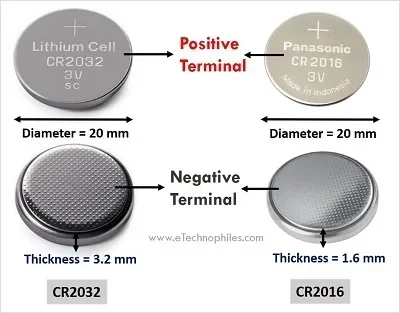
The numbers in the name tell you the size. The “20” means the battery is 20mm in diameter. The last two digits tell you the thickness. So the CR2016 is 1.6mm thick and the CR2032 is 3.2mm thick. That 1.6mm difference changes everything about how and where you can use each battery.
These batteries are popular because they are cheap, reliable, and widely available. You can find them at almost any grocery store, pharmacy, or auto parts shop. But just because they look alike does not mean they work the same way.
Why the “CR” Prefix Matters
The “CR” prefix tells you the battery chemistry. It means lithium manganese dioxide. This chemistry is known for a high energy density and a flat discharge curve. In plain language, that means the battery delivers steady power until it dies, rather than slowly fading out. This is important for devices that need consistent voltage to work properly.
Other battery prefixes you might see include BR and EC. The BR prefix uses a different lithium chemistry that handles higher temperatures. The EC prefix is similar to CR but made by specific manufacturers. For most everyday devices, the CR chemistry is what you need.
Key Differences Between CR2016 and CR2032
Now let us break down the real differences. Understanding these will help you choose the right battery every single time.
Thickness and Physical Size
The most obvious difference is thickness. The CR2016 is 1.6mm thin, and the CR2032 is 3.2mm thick. That means the CR2032 is exactly twice as thick as the CR2016. You cannot swap them in devices that have a fixed battery compartment depth. The CR2016 will rattle around in a CR2032 slot, and the CR2032 simply will not fit into a CR2016 slot.
Capacity and Energy Storage
Capacity is measured in milliamp hours, or mAh. The CR2016 typically has about 75 mAh of capacity. The CR2032 usually has around 220 to 235 mAh. That is a huge difference. The CR2032 holds nearly three times the energy of the CR2016.
What does this mean in real life? A device running on a CR2032 will last much longer between battery changes. If you put a CR2016 in a device designed for a CR2032, the battery will die much faster. You will be buying replacements more often.
Voltage Output
Here is where things get tricky. Both the CR2016 and CR2032 deliver 3 volts of nominal voltage. This is why some people think they are interchangeable. The voltage is the same, but the capacity and physical size are completely different.
Think of it like two water bottles. Both bottles hold water at the same pressure, but one bottle is much bigger than the other. The bigger bottle lasts longer. That is exactly how these two batteries compare.
Weight and Dimensions
The CR2016 weighs about 1.8 grams. The CR2032 weighs around 3.0 grams. Both have a 20mm diameter, so they fit the same width of battery contacts. But the weight difference matters in very small devices where every gram counts. It also affects how the battery sits in the compartment and whether it makes proper contact.
| Feature | CR2016 | CR2032 |
|---|---|---|
| Diameter | 20mm | 20mm |
| Thickness | 1.6mm | 3.2mm |
| Voltage | 3V | 3V |
| Typical Capacity | ~75 mAh | ~220 mAh |
| Weight | ~1.8g | ~3.0g |
| Chemistry | Lithium Manganese Dioxide | Lithium Manganese Dioxide |
| Common Uses | Small watches, calculators, thin devices | Key fobs, remotes, computers, automotive |
Can You Use CR2016 Instead of CR2032?
This is the question most people ask, and the answer is not a simple yes or no. It depends on the device and the situation.
In most cases, you should not swap these batteries. The CR2016 is too thin to make reliable contact in a CR2032 compartment. It might work temporarily if you push it down, but it will likely lose connection. The CR2032 is too thick to fit into a CR2016 slot. Forcing it in can damage the battery holder or the device itself.
When a CR2016 Might Work in a CR2032 Device
There are rare cases where a CR2016 can work in a device designed for a CR2032. If the battery compartment has extra spring tension or a loose fit, the thinner battery might make contact. But this is not a reliable solution. The battery will pop out easily, and the device will lose power unexpectedly.
Some people try to stack a CR2016 with a small spacer to fill the gap. This is a bad idea. The spacer can cause uneven pressure, poor contact, and even short circuits. Stick with the battery size the manufacturer recommends.
When a CR2032 Might Work in a CR2016 Device
This almost never works. The CR2032 is simply too thick. It will not fit into a compartment designed for the slimmer CR2016. Trying to force it in can bend the battery contacts or crack the device housing. This is especially true for small automotive devices like key fobs and remote start transmitters.
What Happens If You Use the Wrong Battery?
Using the wrong battery can cause several problems. The device may not turn on at all. It might work intermittently and then stop. In worst-case scenarios, the battery can leak or overheat. Lithium batteries are generally safe, but forcing the wrong size into a compartment creates unnecessary risk.
Devices That Use CR2016 and CR2032 Batteries
Both of these batteries show up in everyday devices. But they are not always interchangeable. Here is where you will find each one.
Common CR2016 Applications
- Thin wristwatches: Many dress watches and fashion watches use the slim CR2016 because the battery compartment is very shallow.
- Small calculators: Basic handheld calculators often use the CR2016 for its compact profile.
- Digital thermometers: Small kitchen or medical thermometers frequently run on this battery.
- Car dash cameras: Some compact dash cameras use the CR2016 for its thin profile, which fits in tight spaces.
- Garage door openers: Certain compact remote models use the CR2016.
Common CR2032 Applications
- Car key fobs: This is the most common use for the CR2032. Almost every modern car key fob uses this battery.
- Computer CMOS batteries: Your motherboard uses a CR2032 to keep your BIOS settings and system clock running when the PC is off.
- TV remotes: Most standard TV remotes use the CR2032 because it fits well and lasts a long time.
- Smoke detectors: Many hardwired smoke detectors use a CR2032 as a backup power source.
- Automotive TPMS sensors: Some tire pressure monitoring system sensors run on CR2032 batteries.
- Remote start systems: Aftermarket remote start fobs for vehicles commonly use the CR2032.
Automotive-Specific Uses
In the automotive world, the CR2032 is the go-to battery for key fobs and remote controls. If you have ever had to replace the battery in your car key, it was almost certainly a CR2032. The CR2016 is less common in cars, but you may find it in compact remote start transmitters or certain dashboard warning light indicators.
If you are working on a car and need a replacement battery, always check the owner’s manual or the battery markings on the old cell. Putting the wrong battery in a key fob can cause the fob to fail, which means you cannot unlock or start your car.
How to Choose the Right Battery for Your Device
Choosing the correct battery is simple if you follow a few steps. Do not guess. Do not assume that because two batteries look similar, they are the same.
Step 1: Check the Device Manual
The fastest way to find the right battery is to look at the device manual. It will list the exact battery type, including the model number. If you no longer have the manual, check the manufacturer’s website. Most brands have PDF manuals available for free download.
Step 2: Look at the Old Battery
If you are replacing a dead battery, look at the old one. The model number is printed right on the top. It will say something like CR2016 or CR2032. Take a photo of it with your phone so you have the number handy when you go to buy a replacement.
Step 3: Measure the Thickness
If the old battery is unreadable, use a ruler or caliper to measure the thickness. A CR2016 will measure close to 1.6mm. A CR2032 will measure close to 3.2mm. Even a small difference in thickness matters when it comes to battery fit and contact pressure.
Step 4: Buy from Reputable Brands
Not all coin cell batteries are created equal. Cheap off-brand batteries may have lower capacity and shorter shelf life. Stick with trusted brands like Energizer, Duracell, Panasonic, or Sony. These brands consistently deliver reliable performance and have better quality control.
Quick Tips
- Always match the battery model number exactly. Do not substitute CR2016 for CR2032 or vice versa.
- Store batteries in a cool, dry place. Heat reduces the shelf life of lithium coin cells.
- Check the expiration date. Even unused batteries lose charge over time.
- Dispose of old batteries properly. Take them to a recycling center. Do not throw them in the trash.
- Keep spare batteries in their original packaging. This prevents them from shorting out against other metal objects in your drawer.
Common Mistakes and Expert Insights
Even careful people make mistakes when it comes to batteries. Here are the most common errors and how to avoid them.
Common Mistakes
- Assuming same voltage means same battery: Just because both batteries output 3 volts does not mean they are interchangeable. The capacity and thickness are different.
- Forcing a battery into a tight compartment: If the battery does not fit easily, it is the wrong size. Forcing it can damage the device and create a safety hazard.
- Mixing old and new batteries: Never put a new CR2032 with an old CR2016 in the same device. The old battery will leak and can corrode the compartment.
- Ignoring the expiration date: Batteries have a shelf life. A stale battery may not hold enough charge to power your device properly.
- Buying the cheapest option: Low-quality coin cell batteries may have inconsistent voltage output and shorter life spans. You get what you pay for.
Expert Insights on Battery Selection
Battery technicians recommend always keeping a spare of the exact battery your device uses. For automotive applications, this is especially important. A dead key fob battery can leave you stranded, and having a replacement ready saves time and frustration.
Experts also advise against storing batteries in the refrigerator. While cold temperatures slow chemical reactions, the moisture inside a fridge can cause condensation on the battery, which leads to corrosion. A cool, dry drawer is the best storage spot.
Another expert tip: when you insert a new battery, make sure the positive side faces up. On most coin cell batteries, the positive side has the model number printed on it. The negative side is usually smooth and flat. Putting the battery in backwards will prevent the device from working.
CR2016 vs CR2032: Final Verdict
The CR2016 and CR2032 are not the same battery. They share the same chemistry and voltage, but they differ in thickness, capacity, and the devices they power. The CR2016 is thin and compact, ideal for small electronics. The CR2032 is thicker and holds more energy, making it the standard for key fobs, remotes, and automotive devices.
When in doubt, always check the battery compartment or the device manual. Using the correct battery ensures optimal performance, safety, and longevity for your electronics. Taking a few extra seconds to verify the battery type can save you from costly repairs and frustrating device failures.
If you own a car, keep a spare CR2032 in your glove box. Most car key fobs use this battery, and having one on hand means you are never stuck with a dead fob. For smaller electronics like watches and thermometers, the CR2016 is your best bet. Understanding these differences gives you confidence every time you need a replacement.
Frequently Asked Questions
Can I use a CR2032 in place of a CR2016?
No, you should not. The CR2032 is 3.2mm thick while the CR2016 is only 1.6mm thick. The CR2032 will not fit into a compartment designed for the slimmer CR2016. Forcing it in can damage the device and the battery compartment.
Can I stack a CR2016 and CR2032 together to get more power?
This is not a safe or recommended practice. Stacking mismatched batteries creates uneven pressure, poor electrical contact, and a risk of short circuits. Always use the battery size specified by the device manufacturer.
How long does a CR2032 battery last in a car key fob?
A CR2032 battery typically lasts between two and four years in a car key fob. The exact lifespan depends on how often you use the fob and the distance between the fob and the car. If you notice the range getting shorter, it is time to replace the battery.
Are CR2016 and CR2032 batteries rechargeable?
No, both the CR2016 and CR2032 are primary lithium batteries. This means they are designed for single use and should not be recharged. Attempting to recharge a primary lithium battery can cause it to leak, overheat, or even catch fire.
What other batteries are similar to the CR2032?
The CR2025 is the closest alternative. It has the same 20mm diameter but is 2.5mm thick, making it thinner than the CR2032. The CR2025 is not a perfect substitute either, as it has a lower capacity than the CR2032. Always check your device requirements before choosing a replacement.
Where can I buy CR2016 and CR2032 batteries?
You can find both batteries at grocery stores, pharmacies, auto parts stores, and online retailers. Major brands like Energizer and Duracell are widely available. For automotive applications, your dealership or auto parts store will also carry these batteries in stock.
Conclusion
The question “is CR2016 the same as CR2032” comes up often, and the answer is clear. These two batteries are not the same. They share a similar shape and voltage, but the differences in thickness and capacity make them non-interchangeable for most devices. Whether you are replacing the battery in your car key fob, a watch, or a remote control, using the correct battery is essential.
Remember the key facts. The CR2016 is thin and compact with about 75 mAh of capacity. The CR2032 is thicker and holds roughly 220 mAh. Both deliver 3 volts of power. But size and capacity matter more than voltage when it comes to real-world performance.
Take a moment to check your devices today. If you are not sure which battery you need, look at the old one or consult the device manual. Making the right choice keeps your electronics running smoothly and avoids unnecessary frustration. A small battery may seem insignificant, but using the correct one makes a big difference in how long your devices last and how safely they operate.
Frequently Asked Questions
What is Is CR2016 the Same as CR2032??
Is CR2016 the Same as CR2032? is an important topic with many practical applications.