How Bugattis W16 Engine Layout Improves Acceleration
Bugatti’s W16 engine layout is a masterclass in engineering that delivers mind-blowing acceleration. With four turbochargers, 16 cylinders, and over 1,500 horsepower, this engine powers some of the fastest production cars ever built. The unique W-shaped design shortens the engine length, improves airflow, and reduces turbo lag for instant throttle response. Whether you are a car enthusiast or just curious about extreme performance, understanding this layout reveals why Bugatti dominates the speed world.
When you think about the fastest cars on the planet, Bugatti probably comes to mind. And at the heart of every Bugatti hypercar sits something truly extraordinary. The Bugatti W16 engine layout is not just an engine. It is a masterpiece of engineering that redefines what is possible on four wheels.
But how exactly does this layout make Bugattis so incredibly fast? Why does the W16 design give these cars such brutal acceleration? Let us break it all down in simple terms. You do not need to be a mechanic to understand why this engine is so special.
The W16 engine has 16 cylinders arranged in a unique W shape. Four turbochargers force air into the engine. Together, these components produce more than 1,500 horsepower. That kind of power turns a 2-ton car into a rocket. The way the engine is built directly impacts how quickly it can accelerate. Every angle, every cylinder, every turbocharger plays a role.
Key Takeaways
- Unique W-Shape Design: The W16 layout combines two VR8 banks into a compact, powerful engine that fits in a mid-engine car.
- Four Turbochargers: Quad-turbocharging eliminates lag and delivers smooth, massive power across the entire rev range.
- Shortened Crankshaft: A shorter crankshaft reduces engine length, improving weight distribution and acceleration response.
- Massive Horsepower and Torque: The layout supports over 1,500 hp and 1,180 lb-ft of torque for jaw-dropping 0-60 times.
- Advanced Cooling System: An efficient cooling setup keeps the 16 cylinders running at peak performance under extreme loads.
- Throttle Response: The compact design allows faster throttle response, meaning the car reacts instantly when you press the pedal.
- Engineering Innovation: Bugatti’s W16 represents decades of research into cylinder arrangement, forced induction, and power delivery.
📑 Table of Contents
- What Makes the W16 Engine Layout So Special
- Quad-Turbocharging: The Secret to Instant Power
- Engine Displacement and Power Output
- Crankshaft Design and Engine Compactness
- Cooling and Thermal Management
- Real-World Acceleration Performance
- Common Mistakes People Make About W16 Engines
- Expert Insights on the W16 Layout
- How the W16 Layout Compares to Other Engine Configurations
- Key Takeaways
- Frequently Asked Questions
- Conclusion
What Makes the W16 Engine Layout So Special
The Bugatti W16 engine layout is unlike anything else on the road. Most cars use four, six, or eight cylinders. Bugatti chose 16. And they arranged them in a W shape instead of a straight line or a V. This choice changes everything about how the engine works.
The W Configuration Explained
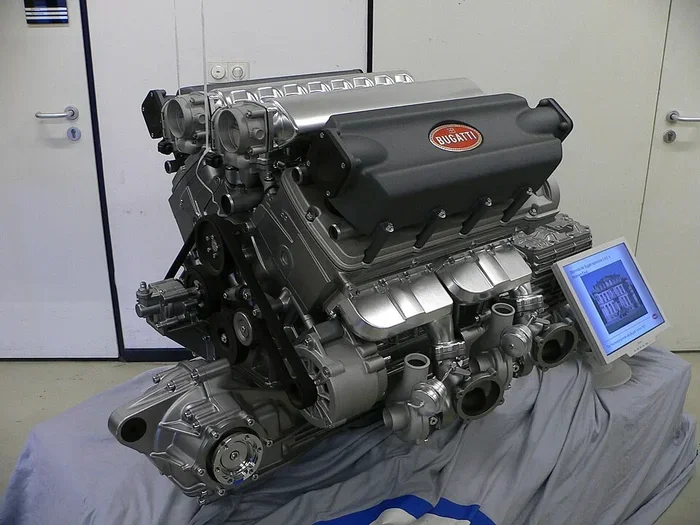
Imagine taking two narrow-angle V engines and placing them side by side. They share a single crankshaft in the middle. That is essentially what a W16 is. The two banks of eight cylinders each lean inward at a narrow angle. This creates a compact shape that is shorter and narrower than a traditional V16.
Why does this matter for acceleration? A shorter engine means the weight sits closer to the middle of the car. Better weight distribution means the tires grip the road more evenly. When the driver hits the throttle, all that power transfers to the ground faster. The car launches harder and reaches top speed sooner.
The W16 configuration also keeps the engine’s center of gravity low. A lower center of gravity reduces body roll during hard acceleration. The car stays planted. The tires maintain contact with the road surface. More contact means more traction. More traction means faster acceleration.
How the Cylinder Banks Work Together
Each cylinder bank in the W16 engine contains eight cylinders. The banks share a common crankshaft, which simplifies the design. Fewer moving parts mean less friction and less weight. Less friction means more power reaches the wheels.
The firing order of the cylinders is carefully engineered. Engineers space out the power pulses evenly. This creates a smooth delivery of force to the crankshaft. Instead of sudden bursts of power, the acceleration feels seamless. The driver feels a constant, relentless push forward.
Each cylinder has its own combustion chamber where fuel and air ignite. The chambers are small and efficient. They burn fuel quickly and completely. More complete combustion means more energy is converted into motion. That energy translates directly into acceleration.
Quad-Turbocharging: The Secret to Instant Power
The Bugatti W16 engine layout uses four turbochargers, not two. This is a huge part of why the engine accelerates so aggressively. Let us look at how quad-turbocharging works and why it matters.
Why Four Turbochargers?
A single turbocharger has to handle all the exhaust gases from all 16 cylinders. That creates a delay. The turbo needs enough exhaust pressure to spin up before it can force more air into the engine. This delay is called turbo lag. When you press the throttle, there is a brief pause before the power arrives.
Bugatti solved this problem by using four smaller turbochargers instead of two large ones. Each turbo handles only four cylinders. Because the exhaust volume per turbo is smaller, the turbines spin up faster. The result is almost zero turbo lag. When you floor the accelerator, the power arrives instantly.
This is why the Bugatti Chiron can go from 0 to 60 mph in less than 2.5 seconds. The turbos are already spinning and ready. There is no waiting. The throttle response is immediate and electric.
Twin-Scroll Turbo Design
Each of Bugatti’s turbochargers uses a twin-scroll design. In a twin-scroll turbo, the exhaust gases are split into two paths. Each path feeds a different set of cylinders. This separation prevents the gases from interfering with each other.
Less interference means the turbos spin more efficiently. More efficient spinning means more air gets pushed into the engine. More air means more fuel can be burned. More fuel burned means more power. And more power means faster acceleration.
The quad-turbo setup also allows the engine to produce peak torque at a lower RPM. Torque is the twisting force that pushes the car forward. Higher torque at low RPMs means the car feels strong right off the line. You do not need to rev the engine high to feel the acceleration.
Exhaust Manifold Integration
The exhaust manifold in the W16 is carefully designed to route gases to the correct turbocharger. Each turbo receives a balanced flow of exhaust. This balance keeps all four turbos spinning at the same speed.
Balanced turbo speeds mean consistent power delivery. The engine does not lurch or hesitate. The acceleration feels smooth and relentless. This is a key reason why Bugatti cars feel so different from other supercars.
Engine Displacement and Power Output
The Bugatti W16 engine layout displaces 8.0 liters of air and fuel. That is a massive amount of volume. More displacement means more air can be drawn into the cylinders. More air means more fuel can be injected. More fuel burned per cycle means more power.
Horsepower Numbers That Speak for Themselves
The standard Bugatti Chiron produces 1,479 horsepower. The Chiron Super Sport pushes that to 1,578 horsepower. The most powerful version, the Chiron Super Sport 300+, hits 1,600 horsepower. All of this comes from the same basic W16 layout.
Here is a quick comparison of the power figures:
- Bugatti Chiron: 1,479 hp and 1,180 lb-ft of torque
- Bugatti Chiron Sport: 1,479 hp with improved weight distribution
- Bugatti Chiron Super Sport: 1,578 hp and 1,180 lb-ft of torque
- Bugatti Chiron Super Sport 300+: 1,600 hp and 1,180 lb-ft of torque
These numbers are staggering. But the engine layout is what makes them possible. A traditional V10 or V12 engine simply cannot fit four turbochargers and 16 cylinders into the same space. The W configuration makes it work.
Torque and Acceleration
Horsepower gets the headlines. But torque is what actually launches the car. The W16 engine produces 1,180 lb-ft of torque from just 2,000 RPM. That means the car has massive pulling force from a very low engine speed.
When you launch from a standstill, the tires bite into the road with enormous force. The car surges forward. The acceleration feels like being pushed by a freight train. And it keeps going. The torque stays flat across a wide RPM range, so the push never lets up.
This is why the Bugatti W16 engine layout is so effective for acceleration. It delivers power where you need it most. Right from the start.
Crankshaft Design and Engine Compactness
The crankshaft is the backbone of any engine. It converts the up-and-down motion of the pistons into rotational motion. In the Bugatti W16, the crankshaft is shorter than what you would find in a traditional V16 engine.
Shorter Crankshaft, Better Packaging
A shorter crankshaft means a shorter engine. A shorter engine fits better in the car. In a mid-engine layout like the Bugatti, the engine sits behind the driver. A compact engine allows the designer to place more weight over the rear wheels.
More weight over the drive wheels means better traction during acceleration. The tires grip the road more effectively. The car accelerates harder without spinning the wheels. This is especially important when launching from a stop or exiting a corner.
The crankshaft design in the W16 also reduces vibration. A shorter crankshaft is stiffer. A stiffer crankshaft bends less under load. Less bending means the pistons fire more precisely. More precise firing means smoother power delivery. Smoother power means better acceleration.
Piston Arrangement and Firing Order
The 16 pistons in the W16 engine are arranged in two banks of eight. Each bank has a narrow angle of about 15 degrees between the cylinder rows. This tight angle keeps the engine compact.
The firing order is sequenced to balance the forces on the crankshaft. Engineers carefully time each piston’s power stroke. This timing ensures that power is delivered in a continuous, even flow. The result is an engine that accelerates smoothly without jerking or hesitation.
The piston arrangement also affects how heat is distributed. Even heat distribution means more consistent performance. The engine maintains peak power for longer. This translates into sustained acceleration rather than a brief burst that fades.
Cooling and Thermal Management
Generating 1,500+ horsepower creates an enormous amount of heat. If the engine overheats, power drops. Acceleration suffers. The Bugatti W16 engine layout uses an advanced cooling system to keep temperatures in check.
Intercooler Technology
Each turbocharger compresses air before it enters the engine. Compressed air gets hot. Hot air is less dense, which means less oxygen enters the cylinders. Less oxygen means less power.
Bugatti uses large intercoolers to cool the compressed air before it reaches the cylinders. The intercoolers are integrated into the front of the car. They use airflow from driving to dissipate heat. Cooler, denser air means more oxygen. More oxygen means more fuel can be burned. More fuel burned means more power and better acceleration.
Oil Cooling System
The W16 engine also features a dedicated oil cooling circuit. The oil keeps the pistons, bearings, and camshafts at the right temperature. Consistent oil temperature means consistent engine performance. The engine does not lose power as it heats up.
This matters for acceleration because you want the same level of power whether you are on the first lap or the tenth. The cooling system ensures the engine architecture stays effective under repeated hard acceleration.
Real-World Acceleration Performance
The engineering behind the Bugatti W16 engine layout translates into real-world numbers that are hard to believe.
0 to 60 MPH Times
The Bugatti Chiron accelerates from 0 to 60 mph in about 2.4 seconds. The Chiron Super Sport 300+ achieves similar numbers. For context, most sports cars take 3 to 4 seconds to reach 60. The Bugatti does it in less than half that time.
Here is how the acceleration compares:
- Bugatti Chiron: 0-60 mph in 2.4 seconds
- Bugatti Chiron Sport: 0-60 mph in 2.4 seconds
- Bugatti Chiron Super Sport: 0-60 mph in 2.3 seconds
- Bugatti Chiron Super Sport 300+: 0-60 mph in 2.3 seconds
These times are a direct result of the W16 engine layout. The compact design, quad-turbocharging, and massive torque all work together to launch the car with incredible force.
Quarter-Mile Performance
The Bugatti Chiron covers the quarter-mile in about 9.6 seconds. The Super Sport 300+ does it even faster. These are figures that rival purpose-built drag cars. And the Bugatti is a road-legal grand tourer that can also cruise comfortably at highway speeds.
The power delivery from the W16 engine is so effective that the car does not just launch hard. It keeps accelerating deep into the quarter-mile. The engine maintains strong power output even at high speeds. This sustained acceleration is what separates hypercars from ordinary sports cars.
Top Speed and Sustained Acceleration
The Bugatti Chiron Super Sport 300+ reached a top speed of 304.77 mph. This record-breaking run was possible because of the W16 engine layout. The engine produces enough power to overcome aerodynamic drag at extreme speeds.
Sustained acceleration at high speed requires enormous power. Air resistance increases with the square of speed. Doubling your speed quadruples the drag force. The W16 engine has the horsepower to push through that resistance. The four turbochargers keep feeding the engine the air it needs, even at extreme velocities.
Common Mistakes People Make About W16 Engines
There are some misconceptions about the Bugatti W16 engine layout that are worth clearing up.
Myth: More Cylinders Always Mean More Power
Having 16 cylinders does not automatically make an engine fast. The arrangement matters. The turbocharging strategy matters. The combustion efficiency matters. A poorly designed 16-cylinder engine can be sluggish and unreliable. Bugatti’s success comes from how all the components work together.
Myth: The W16 Is Just a V16
The W16 is not simply a V16 with two extra cylinders. The W configuration creates a fundamentally different engine shape. The shared crankshaft and narrow cylinder angles make it shorter and more compact. These differences directly impact acceleration and handling.
Myth: Quad-Turbos Add Too Much Complexity
Yes, four turbochargers add complexity. But the benefits far outweigh the drawbacks. The near-zero turbo lag, the massive power output, and the smooth delivery make the complexity worthwhile. Bugatti engineers have spent decades refining this system.
Expert Insights on the W16 Layout
Engineers at Bugatti have spoken about the W16 engine layout in interviews and technical presentations. Here are some key insights from the experts.
Why the W Configuration Was Chosen
According to Bugatti’s engineering team, the W configuration was selected because it offered the best balance of power, compactness, and packaging. A V16 would have been longer. A flat-16 would have been wider. The W shape fit the mid-engine layout perfectly.
The engineers also noted that the narrow-angle cylinder banks allowed for a simpler valve train. Fewer components mean less weight and fewer points of failure. This contributes to the engine’s reliability, which is impressive given the extreme power output.
The Role of Forced Induction
Bugatti’s engineers emphasized that forced induction was non-negotiable. Naturally aspirating a 16-cylinder engine would not produce enough power for their goals. The four turbochargers are essential to reaching the 1,500+ horsepower target. The forced induction system is as much a part of the layout as the cylinder arrangement itself.
How the W16 Layout Compares to Other Engine Configurations
To truly appreciate the Bugatti W16 engine layout, it helps to compare it to other common engine designs.
W16 vs. V12
A V12 engine has 12 cylinders in two banks of six. It is a proven design used by Ferrari, Lamborghini, and Aston Martin. A V12 produces great power but cannot match the W16 in terms of total output. The W16 has four more cylinders and four turbochargers. The result is significantly more horsepower and torque.
However, the V12 is simpler and often more reliable. It has fewer components and less complexity. For everyday driving, a V12 may be more than enough. But for absolute acceleration performance, the W16 wins.
W16 vs. V8 Twin-Turbo
A twin-turbo V8 is found in many modern sports cars. It produces around 600 to 800 horsepower in most applications. The W16 produces nearly double that. The acceleration difference is dramatic. A V8 car might reach 60 mph in 3 seconds. A W16 Bugatti does it in under 2.5 seconds.
The W16 engine layout also delivers torque at lower RPMs. The V8 needs to be revved higher to reach peak torque. The W16 is strong from the moment you step on the gas.
W16 vs. Flat-Six
A flat-six engine, like those used by Porsche, is wide and low. It offers great handling but limited power. A twin-turbo flat-six produces around 500 to 650 horsepower. The W16 dwarfs it in output. The flat-six is a great engine for sports cars, but it is not designed for hypercar-level acceleration.
Key Takeaways
- Compact W-Shape Design: The W16 layout is shorter and narrower than a V16, improving weight distribution and acceleration.
- Quad-Turbocharging: Four turbochargers eliminate lag and deliver instant power for explosive launches.
- Massive Power Output: Over 1,500 horsepower and 1,180 lb-ft of torque make the W16 one of the most powerful engines ever built.
- Low-RPM Torque: Peak torque from 2,000 RPM ensures strong acceleration right off the line.
- Advanced Cooling: Efficient thermal management keeps the engine performing under extreme conditions.
- Smooth Power Delivery: The firing order and crankshaft design create seamless acceleration without jerking or hesitation.
- Engineering Excellence: The W16 represents decades of innovation in cylinder arrangement, forced induction, and engine architecture.
Frequently Asked Questions
Why does Bugatti use a W16 engine instead of a V12?
Bugatti chose the W16 because it fits more cylinders into a compact space. The W shape is shorter than a V16 and allows for a mid-engine layout. Four turbochargers on 16 cylinders produce far more power than a naturally aspirated V12. The W16 was designed specifically for hypercar-level acceleration and top speed.
How does the W16 engine layout reduce turbo lag?
The W16 uses four smaller turbochargers instead of two large ones. Each turbo handles only four cylinders, so it spins up faster. Smaller turbos need less exhaust pressure to reach full speed. This means power arrives almost instantly when you press the throttle. The result is near-zero turbo lag and immediate acceleration.
Is the Bugatti W16 engine reliable given its extreme power?
Bugatti engineers designed the W16 with reliability in mind despite its massive output. The engine uses forged internal components and advanced materials. Regular maintenance and proper care are essential. Bugatti recommends service intervals to keep everything running smoothly. When maintained correctly, the W16 is remarkably durable for an engine producing over 1,500 horsepower.
Can the W16 engine be used in other cars besides Bugatti?
The W16 is a highly specialized engine designed specifically for Bugatti vehicles. Its compact dimensions and quad-turbo setup are tailored to Bugatti’s mid-engine platform. No other manufacturer currently uses a W16 engine. The design is unique to Bugatti and represents their engineering identity.
How does the W16 layout improve weight distribution?
The compact W shape keeps the engine shorter and narrower than a conventional V16. This allows engineers to place the engine further back in the chassis. More weight over the rear wheels improves traction during acceleration. The lower center of gravity also helps the car stay stable under hard acceleration.
What makes the W16 engine different from a regular V8?
The W16 has twice the cylinders of a V8 and uses four turbochargers instead of two. This produces dramatically more horsepower and torque. The W16 also has a more complex cylinder arrangement that requires advanced engineering. The result is a much more powerful engine with significantly better acceleration performance.
Conclusion
The Bugatti W16 engine layout is one of the most impressive engineering achievements in automotive history. Every aspect of the design serves a single purpose: to make the car accelerate faster than anything else on the road.
From the unique W-shaped cylinder arrangement to the quad-turbocharging system, every detail matters. The compact engine fits perfectly in the mid-engine layout. The four turbochargers deliver instant power with zero lag. The massive torque output launches the car like a rocket. And the advanced cooling system keeps everything running at peak performance.
When you understand how the W16 engine layout works, you begin to appreciate why Bugatti cars are in a class of their own. The acceleration is not just fast. It is otherworldly. It is the result of decades of innovation, countless engineering hours, and an uncompromising pursuit of speed.
If you have ever wondered what makes a Bugatti so incredibly quick, now you know. It all starts with the engine. And the Bugatti W16 engine layout is the reason these cars continue to redefine what is possible on four wheels.