Can I Start a Toyota With a Mechanical Key Right Now
Can I Start a Toyota With a Mechanical Key? Yes, many Toyota models accept a physical mechanical key for starting. Older Toyotas use a simple key blade in the ignition, while newer smart key systems may still have a hidden key blade for emergencies. This guide shows you exactly how to start your Toyota with a mechanical key, what to do if your key fob fails, and which models support it.
Have you ever stood by your Toyota, fumbling with a dead key fob, and thought, “Can I start a Toyota with a mechanical key right now?” The answer is a reassuring yes. Whether you drive a classic older model or a modern Toyota with a smart key system, there is almost always a way to use a physical mechanical key to get the engine running. This situation happens more often than you might think. A key fob battery dies, the remote stops working, or you simply misplaced the electronic part. In those moments, knowing how to use the mechanical key blade can save your entire day.
Many Toyota owners are surprised to learn that their vehicle came with a hidden backup key all along. Underneath the smart key fob, there is often a small metal blade tucked away. This is a mechanical key designed specifically for emergencies. Even Toyota models from the early 2000s relied entirely on a traditional metal key and a simple ignition lock cylinder. Understanding how your Toyota key works removes the panic when technology fails. This guide breaks down everything you need to know about starting a Toyota with a mechanical key, from older models to the latest smart key systems.
We will walk you through the exact steps, show you which Toyota models use mechanical keys, and share practical tips to avoid common mistakes. You will learn about transponder chips, key programming, and what to do if your lock cylinder gets stuck. By the end, you will feel confident using your Toyota’s mechanical key anytime. Let us get started.
Key Takeaways
- Older Toyota models (pre-2000s) use a standard mechanical key that turns a traditional ignition cylinder.
- Many newer Toyotas with smart key systems still include a hidden mechanical key blade for backup.
- You can start a Toyota with a mechanical key by inserting it into the ignition slot and turning it to the ON position.
- A dead key fob battery does not prevent you from using the mechanical key to start the engine.
- Some Toyota models require the key to be in a specific slot or position near the start button.
- Knowing how to use your mechanical key can save you from being stranded with a dead key fob.
📑 Table of Contents
- How Toyota Keys Have Evolved Over the Years
- Which Toyota Models Use a Mechanical Key
- Step-by-Step: Starting a Toyota With a Mechanical Key
- What If Your Toyota Has a Smart Key System but No Visible Key Slot?
- Common Problems and Quick Fixes
- When You Need a Replacement Toyota Key
- Expert Insights on Using a Mechanical Key
- Key Takeaways
How Toyota Keys Have Evolved Over the Years
Toyota has used several different key technologies over the decades. Understanding this history helps you figure out what kind of key your specific model needs. The evolution of the Toyota key tells a story of increasing convenience and security. Early Toyotas were simple machines that relied on a basic metal key. Then came transponder keys with embedded chips. Today, many models use a smart key system that lets you start the car with a push button.
The Traditional Mechanical Key Era
Before the 1990s, every Toyota came with a basic mechanical key. This key had a simple cut pattern on the blade. You inserted it into a lock cylinder on the steering column, turned it, and the engine started. There were no electronic chips or antennas. The lock cylinder itself was the only security device. These keys were easy to copy at any locksmith. Many classic Toyota owners still prefer this simplicity because it never fails. A mechanical key does not need a battery. It just needs a properly cut blade that matches the lock tumblers.
The Introduction of Transponder Keys
In the 1990s, Toyota began adding a small transponder chip to the key head. This chip communicates with the engine control unit. When you turn the ignition, the car reads the chip’s unique code. If the code matches, the engine is allowed to start. This stopped simple hot-wiring and made cars much harder to steal. Even with a transponder key, the blade still worked mechanically in the ignition switch. So you still had a Toyota mechanical key function built in. The difference is that the car now also checks for the electronic signal.
The Smart Key and Push-Button Start Revolution
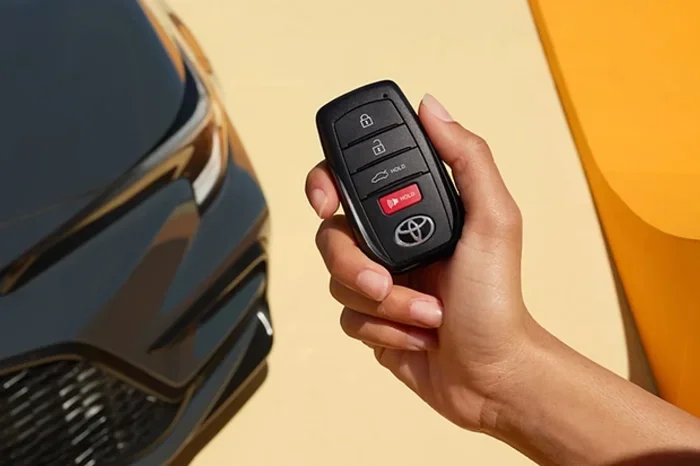
Toyota introduced smart key systems around 2005 on popular models like the Camry and RAV4. With a smart key, you do not need to remove the key from your pocket. You simply press the start button while holding the fob. The car detects the fob’s radio signal and allows the engine to start. However, Toyota did not remove the mechanical key entirely. Instead, they hid a small key blade inside the fob itself. This hidden blade is your emergency backup. You use it to manually unlock the driver’s door or, in some models, to start the car if the fob battery dies.
Which Toyota Models Use a Mechanical Key
Almost every Toyota ever made has some form of a mechanical key option. The way you access it changes, but the core function remains. Here is a breakdown of Toyota models and their key systems.
Older Models That Rely Entirely on Mechanical Keys
Toyota models built before the year 2000 generally use a full mechanical key. These include:
- Toyota Corolla (1983–1999): Uses a standard key in the ignition lock cylinder. No electronics involved.
- Toyota Camry (1986–1999): Same simple mechanical key system. Very reliable and easy to replace.
- Toyota Pickup / Tacoma (1988–1997): The older Tacomas use a basic mechanical key for the ignition and doors.
- Toyota Land Cruiser (1980–1998): A sturdy mechanical key that works in a traditional lock cylinder.
On these older vehicles, the entire start process is mechanical. You insert the key, turn it to the ON position, and then to the START position. The engine cranks and fires up. There is no need for a transponder chip or battery. This is the simplest form of Toyota ignition operation.
Newer Models with Hidden Mechanical Key Blades
Modern Toyota models use smart key systems but still include a mechanical key blade for emergencies. These include:
- Toyota Camry (2007–present): The smart key fob contains a hidden key blade. You slide a small latch on the fob to release the blade.
- Toyota Corolla (2014–present): Uses a smart key with a concealed mechanical key inside the fob.
- Toyota RAV4 (2013–present): The key fob has a fold-out metal blade for manual door unlocking and emergency starting.
- Toyota Highlander (2008–present): Same smart key design with a hidden mechanical backup key.
- Toyota Tacoma (2016–present): The smart key fob includes a key blade that can start the truck if the fob battery dies.
On these newer models, the mechanical key blade serves two purposes. First, it unlocks the driver’s door if the keyless entry fails. Second, it can start the engine when placed in a specific slot or held near the start button. The exact method depends on the model year. We will cover the step-by-step process next.
Step-by-Step: Starting a Toyota With a Mechanical Key
Starting your Toyota with a mechanical key is straightforward once you know the steps. The process is slightly different depending on whether you have an older model or a newer smart key model. Follow these instructions carefully.
For Older Toyota Models with a Traditional Ignition
If your Toyota was built before the year 2000, you likely have a full mechanical key. Here is how to start it:
- Locate the ignition lock cylinder. It is on the steering column, usually on the right side. You will see a round hole with a keyhole.
- Insert the mechanical key fully into the ignition. Make sure the key is pushed in all the way. The key blade should sit flush with the lock cylinder.
- Turn the key to the ON position. This is the first click. You will hear the dashboard lights come on. The fuel pump may prime for a few seconds.
- Turn the key to the START position. This is the second click. The engine will crank and then start. Release the key immediately; it will spring back to the ON position.
- Let the engine idle for a few seconds. This allows the oil to circulate and the engine to warm up slightly before driving.
That is it. No electronics, no batteries, no fuss. The Toyota mechanical key works purely through the physical match between the key cuts and the lock tumblers. If the key turns smoothly and the engine starts, your ignition switch is working perfectly.
For Newer Toyota Models with a Smart Key System
On Toyota models with a push-button start, the hidden mechanical key blade can still start the car. Here is what to do when your key fob battery is dead:
- Remove the mechanical key blade from the smart fob. Look for a small button or latch on the side of the fob. Press it and slide the blade out.
- Unlock the driver’s door using the mechanical key blade. Insert the blade into the door lock cylinder and turn it to unlock.
- Enter the vehicle and sit in the driver’s seat. Make sure the mechanical key blade is still in your hand or placed in the correct location.
- Locate the emergency key slot. On most Toyota models with a smart key, there is a small slot near the start button or inside the cup holder area. The slot is usually marked with a key icon.
- Insert the mechanical key blade into the emergency slot. Push it in until you feel it click or the dashboard recognizes the key.
- Press the start button with your foot on the brake pedal. The engine should start even though the smart fob battery is dead. The car reads the transponder signal from the key blade’s embedded chip.
Some Toyota models require you to hold the mechanical key blade directly against the start button instead of inserting it into a slot. Check your owner’s manual for the exact location. The key blade contains a small transponder chip that communicates with the car’s antenna ring around the ignition. This allows the engine to start using the backup key.
Quick Tips for Smooth Mechanical Key Starting
- Keep the mechanical key blade clean. Dirt and grime can build up on the blade and prevent it from turning smoothly in the lock cylinder.
- Do not force the key. If it does not go in or turn easily, stop. Forcing it can break the key inside the lock.
- Check the key blade for wear. A worn blade will not match the lock tumblers properly. You may need a Toyota key replacement if the cuts are rounded off.
- Always carry the backup key blade separately. If your smart fob fails completely, the hidden blade is your only way to start the car. Keep it in a safe place like a small pouch in your glovebox.
What If Your Toyota Has a Smart Key System but No Visible Key Slot?
Some Toyota owners panic when they cannot find the emergency key slot. They wonder if their car can even be started with a mechanical key. The truth is that almost every Toyota smart key system has a backup method. The slot might be hidden in plain sight.
On many Toyota models, the key slot is located inside the steering column cover, just below the ignition. You might need to remove a small plastic cover to reveal it. On other models, the slot is in the center console near the gear shifter. Some Toyota vehicles use the key blade by simply holding it against the start button while pressing it. The car’s antenna system picks up the transponder signal from the key blade.
If you are unsure where your Toyota’s emergency key slot is, check the owner’s manual. You can also look for a small key icon on the dashboard or center console. The Toyota ignition system is designed to accept the mechanical key blade as a last resort. It is a fail-safe that ensures you are never completely stranded.
Common Problems and Quick Fixes
Even with a mechanical key, you might run into issues. Here are the most common problems and how to solve them quickly.
The Key Will Not Turn in the Ignition
This is often caused by the steering wheel lock. When you turn off the car, the steering wheel locks in place. This engages a lock pin that also prevents the ignition key from turning. To fix this, gently wiggle the steering wheel left and right while simultaneously trying to turn the key. The lock pin will release, and the key will turn smoothly.
The Engine Cranks But Does Not Start
If the key turns and the engine cranks but refuses to fire, the problem is likely not the key. Check the fuel level first. A dead battery, clogged fuel filter, or faulty spark plugs can also cause this. However, on older Toyotas with a transponder key, a damaged chip in the key head can prevent the engine from starting. The car reads the chip, does not see the correct code, and shuts off fuel delivery. In this case, you need a Toyota key replacement with a properly programmed transponder chip.
The Mechanical Key Blade Breaks Inside the Lock
A broken key inside the lock cylinder is a stressful situation. Do not try to extract it with tweezers unless you can see the broken piece clearly. Instead, call a professional locksmith. They have specialized tools to remove broken key fragments without damaging the lock cylinder. Always keep a spare key in a safe place to avoid this emergency.
The Key Fob Battery Dies Frequently
If your smart key fob battery dies often, it may be time to replace the battery. Use a high-quality CR2032 or CR2025 battery depending on your fob model. Also, check if the fob is damaged or exposed to moisture. A wet fob can cause intermittent failures. Keeping a spare battery in your glovebox is a simple habit that prevents this problem.
When You Need a Replacement Toyota Key
Sometimes the mechanical key is lost, stolen, or too damaged to use. You will need a Toyota key replacement to get back on the road. The process depends on your model year and key type.
For older Toyotas with a basic mechanical key, a locksmith can cut a new key from the lock cylinder code or from a key code card that came with the vehicle. This is a quick and affordable process. For newer Toyotas with transponder chips or smart key systems, the replacement key must be programmed to match your car’s immobilizer system. A Toyota dealership can do this, but an automotive locksmith with the right equipment can also program the key on the spot, often at a lower cost.
When ordering a replacement key, make sure to provide the correct key blank for your specific Toyota model and year. The key blade shape and the transponder frequency vary between models. A professional can verify the exact key you need. Always keep a spare key in a safe location at home. This simple step saves you time and money if your primary key ever fails.
Expert Insights on Using a Mechanical Key
Experienced Toyota mechanics often recommend keeping a mechanical key blade accessible even if you primarily use the smart key fob. Technology can fail, but a simple piece of metal never needs a battery. One veteran Toyota technician shared, “I see customers every week who are locked out because their key fob died. The hidden mechanical key blade is their best friend. It solves the problem in seconds.”
Another common piece of advice is to test your emergency key method before you actually need it. Try starting your Toyota with the mechanical key blade once or twice a year. This ensures the key slides in smoothly and the car recognizes the transponder chip. It also helps you remember the exact location of the emergency key slot. Practice turns a potentially stressful situation into a simple routine.
Automotive locksmiths also emphasize the importance of not using the mechanical key blade as a permanent solution. The hidden blade is designed for emergencies only. If you lose your smart fob entirely, replace it as soon as possible. A proper smart key fob offers convenience and security that a mechanical blade cannot match.
Key Takeaways
- A mechanical key can start your Toyota in almost all situations, including when the smart key fob battery is dead.
- Older Toyotas use a standard mechanical key in the ignition cylinder, while newer models hide a backup blade inside the smart fob.
- The emergency starting process is simple: insert the key blade, turn it to ON, and then to START, or place it in the designated slot and press the start button.
- Keep your mechanical key blade clean and free of damage to ensure it works when you need it most.
- Always carry a spare key and a spare battery for your smart fob to avoid being stranded.
- If your key breaks or gets lost, a qualified locksmith or Toyota dealership can provide a programmed replacement quickly.
Knowing how to start your Toyota with a mechanical key is a valuable skill that every owner should have. It gives you independence from technology and prepares you for unexpected situations. Whether you drive a classic Corolla from the 1990s or a brand-new RAV4 with a smart key system, the mechanical key is your reliable backup. Keep this guide handy, share it with a friend, and never worry about a dead key fob again.